
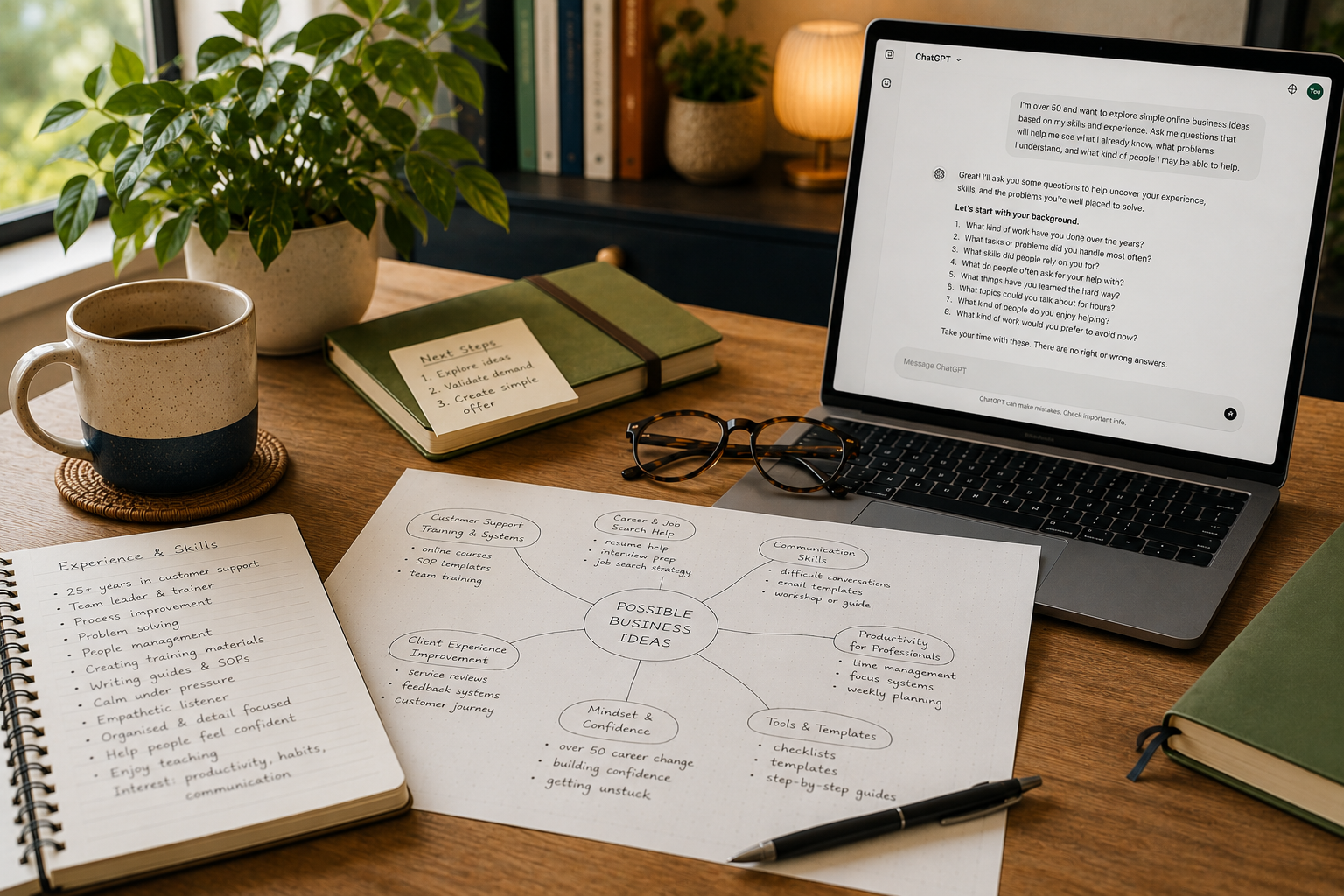
A lot of people over 50 do not struggle because they have no business ideas. They struggle because their experience is scattered across jobs, responsibilities, life changes, lessons, interests, and problems they have solved without thinking much about them. AI can help bring those pieces together, not by choosing a business for you, but by helping you see patterns that are hard to spot when everything is still in your head.
You may spend weeks looking for a unique or clever idea or the perfect niche, but often the first step is much simpler. You need a way to step back from your own experience and see it the way someone else might.
In this guide, I’ll show you how to use AI to explore your skills, work history, life experience, interests, and practical knowledge in a realistic way.
The aim is not to find the perfect idea in one prompt.
The aim is to create a short list of possible directions that feel useful, believable, and close enough to your real experience to explore further.
Finding An Online Business Idea Feels Hard After 50
A lot of online business advice tells you to pick a niche, build a website, start creating content, build a product, choose a platform, or find a way to make money quickly. That advice will prove useful later, but it can feel overwhelming when you are still trying to work out what kind of business fits your actual lifestyle.
The better starting question is more personal: what could I build from my work experience, skills, career knowledge, life lessons, and interests?
You may have spent years helping teams, supporting customers, explaining complex ideas, caring for others, or staying calm when situations got chaotic. Yet when someone asks what online business you could start, your mind may go blank. Many people shrink their own experience without realizing it.
You may think, “I was just in admin,” “I only managed a small team,” “I just helped people sort things out,” or “I do not have anything special.” The word “just” hides a lot. It can flatten years of patience, problem-solving, decision-making, and valuable skills into something that sounds ordinary.
The real issue is that you are too close to your own experience to see what someone else might find helpful.
Why Your Experience Is Not As Ordinary As It Feels
Your experience feels ordinary because you lived it from the inside. The knowledge you use without thinking may be exactly the knowledge someone else is still trying to understand. What feels obvious to you now may feel confusing, stressful, or intimidating to someone facing the same problem for the first time.
Think about someone who spent years handling customer complaints. From the inside, that might feel like part of the job.
From the outside, it could be a useful skill in staying calm, spotting the real issue, choosing the right words, and helping people feel heard. That experience could become advice for small business owners, training material for new managers, or a simple guide for people who struggle with difficult conversations.
Not every part of your life needs to become a business idea. Some experiences are private, some are too personal, and some may matter without becoming content, a product, or a service.
The point is not to turn your whole life into a business. The point is to notice where your experience could help someone make a decision, avoid a mistake, learn a process, or feel less overwhelmed.
A simple online business does not have to begin with a dramatic invention. It can begin with a problem you understand well.
How AI Can Help You Spot Useful Patterns
AI can be useful at this early stage by helping you organize your thoughts. Most people do not have their experience neatly arranged in their heads. They have a mix of job titles, tasks, experiences, frustrations, lessons, interests, and half-formed ideas that do not yet look like a business.
When you give AI those thoughts, it can group your experience into themes. It can identify recurring problems, ask follow-up questions, and highlight areas you may have missed.
That does not mean AI knows the right answer. It means AI can act like a thinking partner while you sort through what is already there.
The useful part is not asking AI for ten random business ideas. The useful part is asking AI to help you see your own background more clearly.
What To Give AI Before Asking For Business Ideas
Vague prompts lead to vague answers.
If you ask AI, “Give me online business ideas for someone over 50,” the answer will probably include the usual list: coaching, consulting, blogging, courses, affiliate marketing, digital products, and freelance services. Those ideas are not necessarily wrong, but they will probably feel disconnected from your real life.
AI becomes more useful when you give it proper context. Before asking for business ideas, give AI the raw material from your own background. The raw material does not need to be polished. A rough list is often better because it gives AI something honest to work with.
Include the kind of work you have achieved, the problems you solved many times, the skills people relied on you for, and the questions people often asked you. Add lessons you learned the hard way, topics you keep coming back to, and work you would rather avoid.
That last part matters because a business idea needs to fit your energy, not just your experience.
It also helps to tell AI what kind of business would suit your life. You might prefer quiet writing over client calls. You might enjoy helping people one-to-one. Consider a small side project rather than a full-time business. AI cannot know those details unless you include them.
How To Ask AI For Better Business Ideas
A good AI prompt does not need to sound clever.
You do not need to tell AI to act as a world-class strategist, a business genius, or a startup expert. That kind of language can push the answer toward generic business advice that does not feel like you.
Start with a simple prompt like this:
I am over 50 and want to explore online business ideas based on my skills and experience. Ask me questions that will help me see what I already know, what problems I understand, and who I may be able to help.
That prompt works because it asks the AI to help you think before it answers. Once you have answered the questions, use a second prompt:
Based on my answers, organize my experience into 3 to 5 possible online business themes. For each theme, explain what problem I might help with, who might need that help, and why my experience could be useful. Do not choose the final idea for me.
After that, ask AI to narrow the list:
Which of these ideas feels most connected to my real experience? Which ideas feel too broad, too generic, or too far away from what I actually know? Ask me any questions that would help narrow the list.
The goal is not to collect as many ideas as possible.
The goal is to reduce the list to a few ideas that feel useful, believable, and close enough to your real experience.
How To Decide Which Ideas Fit Your Real Life
AI will often give you ideas that sound generic.
A generic idea may look sensible on the page, but it may not connect strongly to your story, your skills, your audience, or a problem you genuinely understand. For example, AI might suggest “start a productivity coaching business.”
That idea is too broad; you need to dig deeper.
A more useful version could be helping newly promoted managers create calmer weekly planning routines because you spent years managing people through busy periods. The second idea is more specific, more believable, and easier to test.
Before you take an AI suggestion seriously, ask yourself whether the idea fits your real life.
Would you still care about the topic in six months? Do you understand the problem well enough to help someone? Would you enjoy writing, teaching, advising, reviewing, or creating resources around the topic? Does the idea sound like you, or does it sound like something AI invented?
A useful business idea should not require you to become a completely different person. It may stretch you and ask you to learn new skills, but it should still feel connected to your experience, your way of helping people, and the kind of work you actually want to do.
An Example From Darren And The Remote Hive
I have used AI in my own business, The Remote Hive, to think through content, products, and offers for remote job seekers. The most useful results rarely come from asking AI, “What should I sell?” That question is too broad unless I first explain what I am seeing in the real world.
A good example is my work around helping people fix remote job applications that keep getting ignored. I know from reviewing resumes and advising job seekers that many people are not failing because they lack ability.
They often apply with unclear positioning, generic resumes, or applications that do not connect strongly enough to the job.
When I give AI that context, it can help me organize the patterns.
It might suggest guide angles, product ideas, email topics, or clearer ways to explain the problem. Some suggestions are useful. Others sound too polished, too pushy, or too far away from how I speak to my audience.
That is where my own experience has to lead.
AI helps me spread the pieces out on the table. It does not know which pieces belong in my business.
Your Next Step: Ask AI To Map Your Experience
The easiest way to begin is not by asking AI for a business idea straight away.
Start by giving AI a brief map of your experience, then ask it to organize it into possible themes. You can do this in around 20 minutes with a notebook, a document, or directly inside ChatGPT.
Before using AI, answer these four questions in rough notes:
Do not overthink the answers. You are giving AI enough honest material to work with. Once you have your notes, paste them into ChatGPT with the prompts mentioned in this guide.