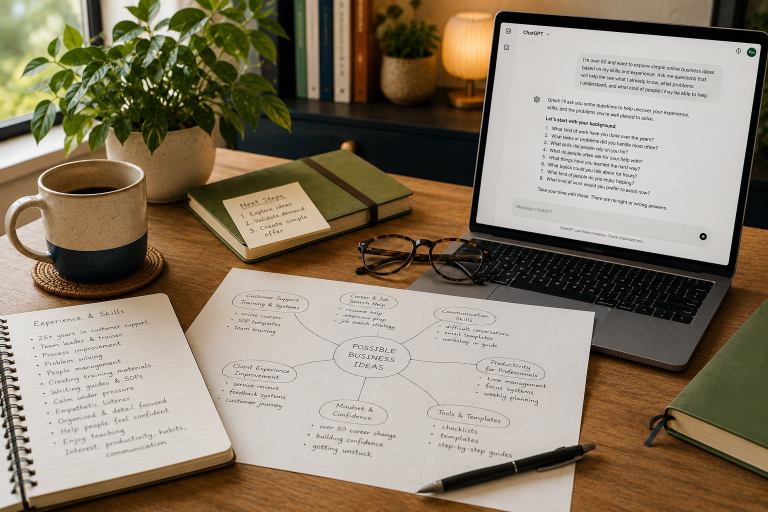

Having a few online business ideas can feel encouraging at first. You start seeing possible directions in your work experience, your skills, your interests, and the problems you have helped people solve before.
Then it gets challenging.
One idea feels more interesting. Another one could make money. Another one feels closer to your real experience, but you are not sure whether anyone would care enough to read about it, join something, buy something, or ask for your help.
That is usually where people get stuck.
Not because there are no ideas, but because choosing one starts to feel like a much bigger decision than it needs to be.
You are not choosing the business you will run for the next five years. You are choosing one idea to explore for a few weeks to see whether it still makes sense once you do something with it.
Why Choosing One Idea Can Feel Hard After 50
Choosing an idea feels different when you know how much work is involved. It is easy to write three or four ideas in a notebook and feel excited about them. The harder part comes later, when you start thinking about the time, energy, and attention each one would need.
At that point, the question is not just “Do I like this idea?” It becomes “Do I actually want to spend the next few weeks working on this?”
That is where the decision can start to feel more difficult than it should. You are not only looking at the idea. You are also thinking about your energy, your patience, your confidence, and whether you really want to start something that could take over your life.
I know that because I fall into it myself.
You compare one idea with another. You ask AI what it thinks. You read another article. You watch another video. You add more notes to the same document. It feels like work, but sometimes it is just a quieter way of avoiding making a decision.
At some point, more thinking does not give you much more information.
You have to make the decision easier.
Pick one idea, try it, and see what you learn from it.
Why You Do Not Need The Perfect Idea Yet
The first idea does not need to answer every question. It does not need to become your whole business, your niche, or the thing you are known for forever. At this stage, the idea only needs to give you something useful to test.
That takes some pressure off the decision. You are not asking, “Is this the perfect online business idea for me?” You are asking, “Is this worth exploring for a few weeks?”
That is a much easier question to answer.
A useful first idea should help you learn a few things. Do you enjoy thinking and talking about the topic? Can you explain the problem in plain English? Do real people seem to care about it? Could you create one useful post, guide, email, resource, or small offer around it without spending money first?
Sometimes the best idea to start with is not the most exciting one. It may be the one that feels close to something you already understand.
The Difference Between An Idea And A Direction
One thing that helped me think about business ideas more clearly was separating the idea from the direction.
You might write down something like “help people be more productive” or “help people eat better,” and both sound fine when they are sitting in your notes. The problem starts when you try to do something with them.
- Who exactly are you helping?
- What are they struggling with?
- What would you create first?
A direction gives the idea a bit more shape. It does not turn the idea into a full business plan. It just makes the idea clear enough to test.
Healthy eating is a good example. A business idea of “Helping people eat better” could go in almost any direction. “Help men over 50 make simple weekday meals while trying to lose weight” is easier to picture. You can imagine the questions someone might have, the mistakes they might make, and the kind of small resource that could help.
The direction does not have to be perfect. It just needs to be clear enough that you can stop circling the idea and try something with it.
Five Questions To Help You Choose One Idea
When you have a few possible ideas, it is tempting to pick the one that sounds most impressive. I would be careful with that. Some ideas look good on paper but feel heavy once you imagine the actual work.
These questions are not meant to turn the decision into a big exercise. They are just a way to look at your ideas with a bit more honesty.
Is This Idea Close to the Experience I Actually Have?
A good starting point is close to something you already understand. That might come from your career, a personal challenge, a responsibility you carried for years, or a problem people already ask you about.
You do not need to be the world’s leading expert. That is a very high bar, and most people never start if they hold themselves to that standard. You do need enough real experience to say something useful that doesn’t sound like it was copied from the internet.
When an idea connects with your own experience, your examples are better. Your advice has more weight because it comes from something you have actually seen, done, handled, or lived through.
Do I Understand The Problem Well Enough To Help Someone?
A business idea becomes easier to work with when you understand the problem behind it. Broad ideas such as “help people with money,” “help people with health,” or “help people use AI” are hard to test because they lack a specific audience type.
- Who is the person you’re trying to help?
- What is the person stuck on?
- What have they already tried?
- What do they keep getting wrong?
- What would feel like a small relief to them?
If you can explain the problem and have a solution in mind, you probably have a business idea worth exploring.
Would I Still Care About This Topic In A Few Months?
Some ideas feel interesting because they are new. You think about them for a few days, and they give you a bit of energy. Then the novelty fades, and you realize you would not want to write about the topic, talk about it, answer questions about it, or build anything around it.
I find the word passion unhelpful because it makes the decision feel too big. A better question is whether you can imagine returning to the business idea after the interest has worn off. If the idea feels overwhelming before you have started, then it is worth moving on.
Can I Test This Idea Without Spending Money?
A good first idea should be small enough to test without building an online presence around it. You should be able to explore it through a short post, a guide outline, a useful checklist, a simple email, or a conversation.
You should not need a full website, a brand identity, paid ads, a course platform, and months of preparation before you learn anything. That is too much weight to put on an untested idea.
If the idea needs too much setup before you can try it, it may need to wait. The idea might still be useful later, but it’s not a good starting point.
Does This Idea Suit How I Like To Work?
Some ideas look good until you imagine the week-to-week reality. One idea may require many live calls. Another may need regular writing. Another may involve research, templates, email support, video, coaching, or community management.
Be honest with yourself. If you dislike video calls, avoid ideas that rely on live coaching. If you enjoy writing and thinking, an idea built around guides, emails, or simple resources may feel more natural.
The idea has to fit your life as well as the market. Otherwise, you may choose something that looks sensible but quietly drains you.
How AI Can Help You Compare Ideas Without Choosing For You
AI can be useful when you have a few ideas and cannot see them clearly anymore. I would not ask it to choose for you, though. That is where things can go wrong, because AI can sound confident even when it does not really understand your life or the kind of work you want to do.
A better use of AI is to ask it to compare your ideas and point out what you might be missing. It can help you see which idea is too broad, which one may be hard to test, and which one seems closest to your experience.
You could use a prompt like this:
I have three possible online business ideas, and I want to choose one to explore first. Help me compare them based on my experience, the problem I understand, how easy each idea is to test, and whether the idea fits how I like to work. Do not choose for me. Ask questions that will help me decide.
The important part is the last line. You are not handing over the decision. You are using AI to make the decision easier to review.
What To Avoid When Choosing Your First Idea
The first thing I would avoid is choosing the idea that sounds most impressive. Impressive ideas often come with a lot of hidden work. They can make you feel as though you are building something important, while quietly making the first step much harder than it needs to be.
I would also avoid choosing an idea only because AI suggested it. AI can give you a tidy list of business ideas in seconds, but a tidy list is not the same as a useful direction. Some ideas sound good because the wording is polished, not because the idea fits you.
Money matters, of course, but I would be careful about choosing only because something sounds profitable. If you do not understand the audience, dislike the work, or cannot test the idea, the money angle will not help much at the start.
The last thing to avoid is asking for more ideas when you already have enough. There comes a point where more options make the decision worse. You do not need another list. You need one small test.
Choose One Idea To Test For A Few Weeks
Give yourself around 20 minutes for this. Do not turn it into a whole afternoon of planning. The aim is to choose one idea that feels useful, realistic, and simple enough to explore for the next few weeks.
Start with up to three ideas from your notes. Do not add more. If you add more ideas now, you will probably make the decision harder.
For each idea, write a few short notes on three things.
First, why does the idea fit your experience? Write down the skill, interest, problem, or situation it connects to. Keep the answer honest. You do not need to prove anything, but there should be a real link between the idea and something you understand.
Next, who could the idea help? Try not to write something too broad, such as “people who want to be more productive” or “people who need help with money.” Make the person easier to picture.
Finally, how could you test the idea?
That could be a short post, a guide outline, a useful checklist, a conversation, an email, or a small service offer. The test should help you learn whether the idea feels useful to someone else.
Once you have written your notes, you can ask AI to help you compare them:
I am comparing three possible online business ideas. I do not want you to choose for me. Help me compare them based on how closely each idea fits my experience, who each idea could help, and how simply I could test each one over the next few weeks. Point out which ideas seem too vague, too complicated, or too far from my real experience.
After that, come back to one question: Which idea feels useful, realistic, and simple enough to explore for the next few weeks?
That is enough for now. You can return to the other ideas later.