
One of the hardest parts of starting an online business after 50 is not usually a lack of experience. It is knowing which part of your experience could help someone else.
That can feel odd at first.
You may have spent years solving problems, dealing with people, learning from mistakes, and getting better at things without ever thinking of those things as “assets.” After a while, your own knowledge becomes normal because you have lived with it for so long.
In this guide, I want to help you look at your skills, work experience, career knowledge, and life experience in a more useful way. You do not need to pick a business model today.
You do not need to build a website, buy software, create a course, or decide what your future online business will become. The first step is smaller than that. You are going to look at what you already know, notice where useful ideas may be hiding, and use AI carefully to help you see those ideas more clearly.
The First Step Is Not Choosing a Business Model
A lot of people start with the question, “What should I sell?”
I understand why. It feels practical. It also puts a lot of pressure on you before you have worked out what you actually know, who you understand, or what kind of problem you could help with.
A better first question is, “What do I understand that could be useful to someone else?” That question is easier to work with because you are not trying to invent a business from nothing. You are looking back through your own experience and asking what might already be there. A simple online business usually starts with three things:
- Someone you understand
- A problem you can help with
- A simple way to make that helpful
The simple way to help might later become a guide, service, newsletter, template, workshop, coaching offer, or digital product. You do not need to decide that yet.
I’ve made the mistake of jumping ahead too quickly.
A simple idea can turn into questions about names, websites, logos, and whether you need to post on social media every day. Suddenly, you are not exploring an idea anymore. You are planning a business launch.
That is too much too soon.
At this point, you only need to understand what you know, who it might help, and what problem you can explain clearly.
Look for Questions People Already Ask You
One of the easiest places to start is with the questions people already bring to you. Think about your work, family, friends, former colleagues, clients, or community.
- What do people ask your opinion on?
- What have you explained more than once?
- What kind of situation makes someone say, “Can I ask you something?”
Those questions are useful because other people may already see value in your knowledge. You may not see the advice as valuable because the answer feels obvious to you. The person asking is still trying to make sense of something you already understand.
Maybe people ask you about changing careers, handling customers, preparing for interviews, managing money, moving abroad, or getting through a difficult life change. Not every question is a business idea. Some questions are too small, too personal, or not interesting enough for you to build around.
That is fine.
You have not chosen yet. You are only noticing what keeps coming up.
Notice Problems You Understand
Some online business ideas come from professional skills. Others come from lived experience.
Take learning AI after 50, for example.
The important part is not only knowing which tool to open or what prompt to type, but also knowing when to use each. It is understanding the hesitation before you use it, the awkwardness when the answer sounds too polished, and the judgment needed to decide what is actually useful.
The same applies to other parts of life and work. If you have changed careers, moved country, managed people, dealt with customers, supported a family member, or solved the same workplace problem for years, there may be useful knowledge inside that experience.
The value often lies in the details others miss. A person who has never been through the problem may explain the facts. A person who has lived through it can often explain the feeling, the mistakes, and the small decisions that make the problem easier to handle.
You do not need to turn your whole life story into a business. Trying to do that would probably feel too big. A better approach is to choose one narrow problem, one type of person, or one stage of a journey.
Look Beyond Your Job Title
Job titles can be strangely unhelpful when you are looking for business ideas. You might think, “I was just a manager,” or “I was just in admin,” or “I worked in customer support.” Those labels do not show what you actually fixed, explained, organized, calmed down, improved, or kept moving.
A better question is: what did people rely on you for again and again?
Maybe you were the person who could explain the messy system nobody else understood. Maybe you stayed calm when a customer, client, or colleague was frustrated. Maybe you kept spotting the same mistake before it caused a bigger problem.
Those repeated moments are worth paying attention to. A business idea does not always start with a big invention. Sometimes it starts with something people already rely on you to do well.
How AI Can Help Without Taking Over
AI can help at this stage, but only if you give it the right job.
I would not ask AI, “What business should I start?” That question gives the tool too much power and usually leads to answers that sound neat but not very personal. You may get a list of ideas, but it may not tell you much about what fits your experience or how you want to work.
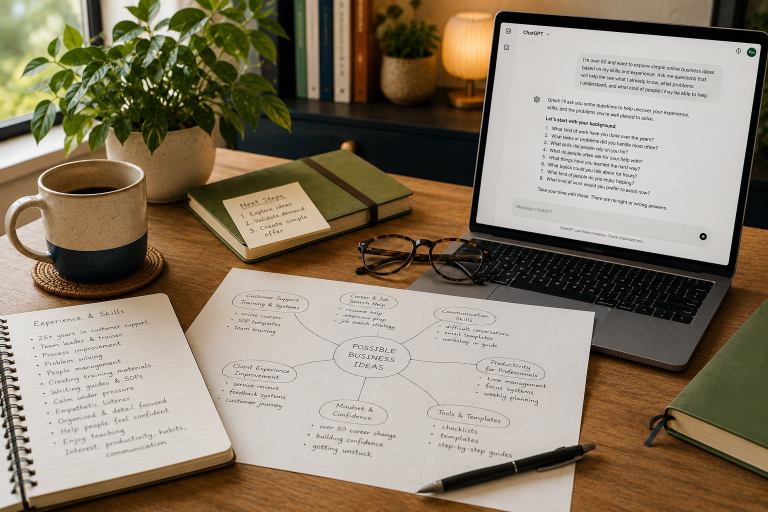
A better use of AI is to give it your rough notes and ask it to help you see what you might be missing. Think of it less like asking for an answer and more like spreading your notes across a table so you can stand back and look at them.
If you are not sure what to write, talk to yourself as you scribble thoughts down in a notebook. Mention the jobs you have done, the questions people ask you, the problems you understand, and the bits of experience you keep dismissing because they feel too obvious.
Then paste those notes into AI and ask:
Here are some rough notes from my work and life experience. Please read them and tell me what keeps coming up. What problems do I seem to understand? What kind of person might find these experiences useful? Do not choose a business idea for me yet.
The answer may not be perfect. That is fine. You are only using AI to help you see your own notes from a different angle. Read the response and notice which parts make you think, “Actually, there might be something there.”
Your Judgment Matters More Than the Tool
AI can make almost any idea sound convincing. That is why I would slow down before taking a suggestion too seriously.
An idea might look good in a list and still be wrong for you. Maybe AI suggests coaching, but you do not want client calls. It suggests a course, but you’d prefer to start with a short guide. Maybe it suggests a broad audience, when the useful part of your experience is much more specific.
I would ask a few plain questions before going any further:
- Would I still care about this topic in six months?
- Do I actually understand the problem, or am I just finding the idea interesting?
- Would I prefer to write, teach, advise, review, or make practical resources?
- Can I explain the idea in normal language to one real person?
- Does the idea sound like me?
That last question matters more than it may seem. AI can polish an idea until it sounds impressive, but impressive is not always useful. If the idea sounds like something you would never say out loud, it probably needs more of you in it.
A useful idea should feel connected to something you understand. It should also feel like something you would not mind exploring properly, not just something that looked clever for five minutes.
How I Use AI in The Remote Hive
I use AI in my own business, The Remote Hive, where I help people secure remote jobs. I do not use AI because I think it has all the answers. I use it because it helps me look at my own work from another angle.
One example was when I reviewed a low-cost product that wasn’t selling as well as I’d expected. I had a landing page that looked clean and trustworthy. The product made sense to me. The problem was that the page did not create enough urgency for the buyer to act.
AI helped me see that gap. The page explained the product, but it did not make the problem feel pressing enough. That was useful feedback because I had been too close to the page.
I still had to decide what to do with the feedback. Some suggestions felt too pushy for my audience. Some lines sounded too polished. Some ideas would have made the page louder, but not necessarily better.
That is the part I try to remember.
You’re in Control of Your Business
AI can point at something worth looking at, but I still have to decide what sounds right, what fits my audience, and what feels honest.
I would use AI the same way when looking for business ideas. Let the tool help you notice what you may have missed, then bring the decision back to your own experience and the kind of work you actually want to build.
Make a Simple Experience Map
Your next step is not to choose your final business idea. That would be too much pressure for one exercise.
Start smaller. Give yourself 20 minutes with a notebook, a blank document, or a notes app. Nobody else needs to see what you write, so do not tidy it up or try to make it sound impressive.
- Write down whatever comes to mind around these questions:
- What have people often relied on me to do?
- What problems do I understand better now than I used to?
- What questions do people bring to me more than once?
- What have I learned the hard way that could help someone else?
Do not turn the answers into a business idea yet.
Just notice what appears on the page.
When you have a few rough notes, paste them into AI and ask:
These are rough notes from my work and life experience. Please help me notice what keeps showing up. What problems do I seem to understand? Who might find this useful? Do not choose a business idea for me yet.
Read the answer slowly. Ignore anything that feels too broad, too generic, or not quite you. Look for one line or one small reaction that makes you think: There might be something here.
That is enough for one step. Starting an online business after 50 does not need to begin with a big public decision. It can begin quietly, with a page of rough notes and a clearer view of what you already know.
Read Next
If you are still unsure what kind of business you could build, read the next guide: How to Find Online Business Ideas From Your Career, Skills, and Life Experience.